
Introduction
The 20mm steel washer is a fundamental fastening component utilized across a vast spectrum of industrial applications. Functionally, it distributes load, prevents damage to joined surfaces, reduces friction, and provides consistent clamping force. Positioned within the mechanical fastening supply chain, it interfaces directly with bolts, screws, and mating components. Its core performance characteristics revolve around load-bearing capacity, dimensional stability, corrosion resistance, and adherence to stringent mechanical property standards. The increasing demands for higher strength-to-weight ratios and extended service life in critical applications are driving the refinement of steel washer manufacturing processes and material compositions.
Material Science & Manufacturing
20mm steel washers are predominantly manufactured from carbon steels, alloy steels, and stainless steels. Carbon steel (typically AISI 1018, 1045) offers a balance of strength and cost-effectiveness. Alloy steels (AISI 4140, 8640) incorporate elements like chromium, molybdenum, and nickel to enhance hardenability, toughness, and tensile strength. Stainless steels (304, 316) provide superior corrosion resistance, particularly important in harsh environments. Raw material properties like yield strength, tensile strength, elongation, and hardness are critical input parameters.
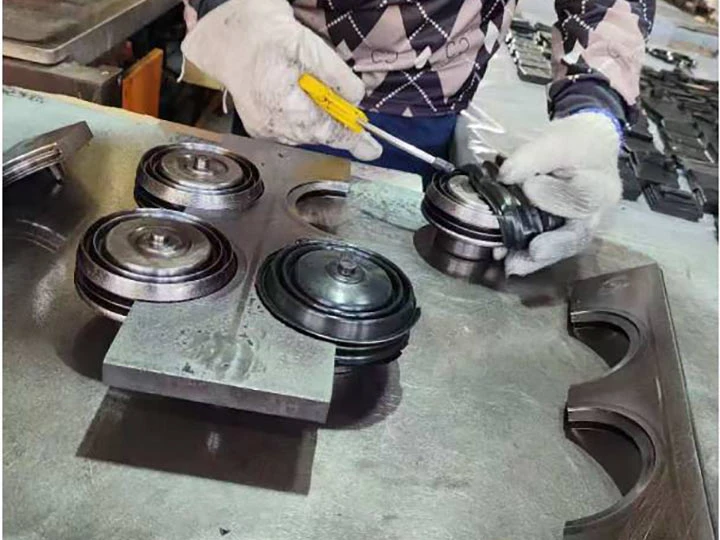
The manufacturing process generally begins with steel coil or bar stock. The material undergoes blanking to create the washer shape using a punching press and die. Critical parameters during blanking include die clearance, punch speed, and material thickness to ensure dimensional accuracy and minimize burring. Secondary operations include deburring (mechanical, chemical, or thermal), heat treatment (hardening, tempering), and surface finishing (plating, coating). Heat treatment significantly influences the washer's mechanical properties. Tempering, in particular, reduces brittleness and improves ductility. Coating options, like zinc plating, phosphate coating, or powder coating, enhance corrosion resistance. Quality control measures at each stage – including dimensional checks, hardness testing, and visual inspection – are vital to ensure conformance to specifications.
Performance & Engineering
The performance of a 20mm steel washer is critically linked to its load-bearing capacity under both static and dynamic conditions. Force analysis requires consideration of the applied load, washer geometry (inner diameter, outer diameter, thickness), and material properties. The washer must withstand compressive stresses without permanent deformation or failure. Fatigue resistance is paramount in applications involving cyclical loading. Environmental resistance, including corrosion resistance and temperature stability, is also crucial. In high-temperature applications, creep and oxidation become significant concerns.
Engineering design considerations include the selection of appropriate material grade, dimensional tolerances, and surface finish. Washers used in conjunction with high-strength fasteners require higher hardness to prevent galling and ensure proper load distribution. Compliance requirements vary depending on the industry. For example, automotive applications demand adherence to IATF 16949 standards, while aerospace applications necessitate compliance with AS9100. Finite element analysis (FEA) is often employed to simulate stress distribution and optimize washer design for specific loading scenarios.
Technical Specifications
| Material Grade | Hardness (HRC) | Tensile Strength (MPa) | Inner Diameter (mm) |
|---|---|---|---|
| AISI 1018 | 30-40 | 440-560 | 21 |
| AISI 4140 | 40-45 | 750-900 | 21 |
| 304 Stainless Steel | 25-35 | 500-700 | 21 |
| 316 Stainless Steel | 25-35 | 550-750 | 21 |
| Carbon Steel (Plated) | 35-45 | 500-650 | 21 |
| Spring Steel | 40-50 | 800-1000 | 21 |
Failure Mode & Maintenance
Common failure modes for 20mm steel washers include fatigue cracking, yielding, corrosion, and surface damage. Fatigue cracking initiates from stress concentrations, often at the inner or outer diameter, and propagates under cyclical loading. Yielding occurs when the applied stress exceeds the material's yield strength, resulting in permanent deformation. Corrosion can weaken the washer material and compromise its load-bearing capacity, particularly in aggressive environments. Surface damage, such as pitting, abrasion, or fretting, can accelerate fatigue cracking and reduce the washer's effective cross-sectional area.
Maintenance typically focuses on preventative measures. Regular inspection for signs of corrosion, damage, or deformation is crucial. Lubrication can reduce friction and prevent galling, particularly in high-stress applications. In corrosive environments, protective coatings should be periodically inspected and reapplied as needed. For critical applications, torque monitoring during assembly is essential to ensure proper clamping force. If failure analysis identifies a recurring issue, the material grade, design, or manufacturing process may need to be revised.
Industry FAQ
Q: What is the impact of material hardness on the performance of a steel washer under high clamping loads?
A: Higher hardness generally correlates with increased resistance to deformation under high clamping loads. However, excessively hard materials can be brittle and susceptible to cracking. The optimal hardness depends on the specific application and material grade. A balance between hardness and toughness is crucial for long-term reliability.
Q: How does the surface finish of a washer affect its corrosion resistance?
A: A smooth surface finish reduces the number of sites where corrosion can initiate. Coatings like zinc plating or powder coating provide a barrier against corrosive elements. Rough surfaces can trap moisture and accelerate corrosion processes. Careful surface preparation prior to coating is also critical for achieving optimal corrosion protection.
Q: What are the key considerations when selecting a washer material for a high-temperature application?
A: Key considerations include the material's creep resistance, oxidation resistance, and thermal expansion coefficient. Stainless steels are often preferred for high-temperature applications due to their superior oxidation resistance. However, the specific alloy composition should be carefully selected based on the operating temperature and environmental conditions.
Q: How important is dimensional accuracy in the manufacturing of 20mm steel washers?
A: Dimensional accuracy is critical, particularly for the inner and outer diameters. Variations in dimensions can affect the clamping force and stress distribution. Tight tolerances ensure consistent performance and prevent premature failure. The required level of accuracy depends on the application's sensitivity to dimensional variations.
Q: What are the common causes of fretting corrosion in steel washers?
A: Fretting corrosion occurs due to small oscillatory movements between contacting surfaces under load. It’s exacerbated by insufficient lubrication, vibration, and surface roughness. The resulting debris can accelerate wear and fatigue failure. Using appropriate lubricants and ensuring proper clamping force can mitigate fretting corrosion.
Conclusion
The 20mm steel washer, despite its seemingly simple design, is a critical component demanding meticulous attention to material selection, manufacturing processes, and performance considerations. Achieving optimal performance necessitates a comprehensive understanding of material properties, stress analysis, and potential failure modes. Its success hinges upon precise adherence to dimensional tolerances, appropriate surface treatments for corrosion mitigation, and the capacity to withstand both static and dynamic loading conditions.
Future trends will likely focus on the development of advanced materials with enhanced strength-to-weight ratios and improved corrosion resistance. The integration of smart washer technologies – incorporating sensors for torque monitoring or fatigue detection – is also a potential area of innovation. Continued refinement of manufacturing techniques, coupled with rigorous quality control, will remain paramount to ensuring the reliability and longevity of these essential fastening components.