
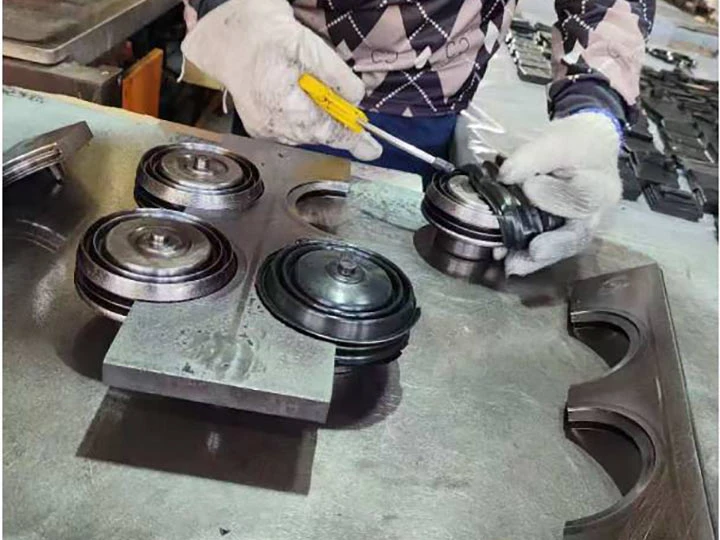
Introduction
Metal rod end caps are critical components used to terminate and protect the ends of metal rods, commonly employed in a diverse range of industrial applications, including hydraulic and pneumatic cylinders, tie rods, and precision linear motion systems. Their function extends beyond simple protection; they are integral to maintaining system integrity, preventing contamination, and ensuring accurate force transmission. Positioned within the broader supply chain of power transmission and structural component manufacturing, these caps represent a specialized segment demanding precision engineering and material selection. Core performance characteristics include corrosion resistance, load-bearing capacity, sealing effectiveness, and dimensional stability, all vital for ensuring the reliable operation of connected machinery. The increasing demand for high-performance, durable components in sectors like aerospace, automotive, and heavy machinery drives continuous innovation in rod end cap design and manufacturing processes.
Material Science & Manufacturing
Rod end caps are typically manufactured from carbon steel (AISI 1045, 1018), alloy steel (4140, 8620), or stainless steel (304, 316). The selection depends heavily on the operating environment and load requirements. Carbon steel offers high strength but limited corrosion resistance, necessitating protective coatings. Alloy steels provide enhanced strength and toughness, suitable for high-stress applications. Stainless steel delivers superior corrosion resistance, essential in harsh environments. Manufacturing processes commonly include cold forming, machining, and welding. Cold forming, specifically cold heading, is often used for initial shaping, providing material grain flow optimization for increased strength. Subsequent machining operations, such as turning, milling, and drilling, refine the dimensions and surface finish. Welding, typically Gas Metal Arc Welding (GMAW) or Gas Tungsten Arc Welding (GTAW), may be employed for creating more complex cap geometries or attaching reinforcing features. Critical parameters during cold forming include die design, lubrication, and material flow control to prevent cracking. Machining requires precise tool selection, cutting speeds, and coolant application to achieve tight tolerances and avoid work hardening. Welding necessitates careful control of heat input, shielding gas composition, and post-weld heat treatment to minimize residual stresses and maintain material integrity. Chemical compatibility testing, particularly concerning coatings applied to carbon steel, is vital to prevent galvanic corrosion when interfacing with dissimilar metals.

Performance & Engineering
The performance of a metal rod end cap is dictated by its ability to withstand static and dynamic loads, resist environmental degradation, and maintain a secure connection. Force analysis, employing finite element analysis (FEA), is crucial during the design phase to determine stress concentrations, predict deformation, and optimize geometry. Factors considered include tensile stress, shear stress, and bending moments. Environmental resistance is paramount, particularly in applications exposed to corrosive media, extreme temperatures, or UV radiation. Stainless steel alloys exhibit inherent corrosion resistance, but even these can be susceptible to pitting or crevice corrosion in chloride-rich environments. Protective coatings, such as zinc plating, nickel plating, or epoxy powder coating, are frequently applied to carbon steel and alloy steel caps to enhance corrosion resistance. Compliance requirements vary by industry. For example, aerospace applications demand adherence to stringent specifications outlined in SAE Aerospace Standards, while automotive applications may require compliance with IATF 16949 quality management standards. Functional implementation often involves incorporating sealing features, such as O-rings or gaskets, to prevent fluid leakage or ingress of contaminants. The selection of the appropriate sealing material, considering chemical compatibility and temperature range, is critical for long-term performance. Furthermore, threaded connections must be engineered to withstand repeated assembly and disassembly cycles without galling or stripping.
Technical Specifications
| Material Grade | Tensile Strength (MPa) | Yield Strength (MPa) | Hardness (HRC) |
|---|---|---|---|
| AISI 1045 | 620-860 | 310-570 | 30-45 |
| 304 Stainless Steel | 517-724 | 205-290 | 20-30 |
| 4140 Alloy Steel | 655-896 | 414-586 | 30-45 |
| 316 Stainless Steel | 586-790 | 241-310 | 20-35 |
| Zinc Plated (over 1045) | 620-860 | 310-570 | 30-45 |
| Epoxy Coated (over 1045) | 620-860 | 310-570 | 30-45 |
Failure Mode & Maintenance
Metal rod end caps are susceptible to several failure modes, including fatigue cracking, corrosion-induced degradation, thread stripping, and deformation under excessive load. Fatigue cracking often initiates at stress concentration points, such as the thread root or the cap's edge. Corrosion, particularly in marine or chemical processing environments, can lead to pitting, crevice corrosion, or galvanic corrosion, weakening the material and compromising its structural integrity. Thread stripping occurs due to excessive torque, improper thread engagement, or material defects. Deformation results from exceeding the cap's yield strength, potentially leading to permanent damage. Regular inspection is critical to identify early signs of failure. Visual inspection can reveal corrosion, cracks, or deformation. Non-destructive testing (NDT) methods, such as dye penetrant inspection or ultrasonic testing, can detect subsurface cracks. Maintenance strategies include applying corrosion inhibitors, lubricating threaded connections, and periodically retorquing fasteners. For caps operating in harsh environments, consider replacing them at predetermined intervals based on operational data and risk assessment. If fatigue cracking is suspected, remove the cap from service and conduct a detailed fracture analysis to determine the root cause. Furthermore, proper storage of unused caps is essential to prevent corrosion and degradation. They should be stored in a dry, protected environment.
Industry FAQ
Q: What material is best suited for rod end caps in a high-temperature hydraulic cylinder application?
A: For high-temperature hydraulic cylinder applications, alloy steel (specifically 4140) is generally preferred over carbon steel and even many stainless steel grades. While 316 stainless steel offers good corrosion resistance, its strength significantly decreases at elevated temperatures. 4140, when properly heat-treated, retains its strength and toughness at temperatures up to approximately 400°C (750°F). However, it will require a protective coating to prevent oxidation at higher temperatures.
Q: How does the surface finish of a rod end cap affect its corrosion resistance?
A: Surface finish plays a crucial role. A rougher surface finish provides more sites for corrosion to initiate. Smoother finishes, achieved through polishing or machining, reduce the surface area available for corrosion and can improve the adhesion of protective coatings. However, excessively polished surfaces can also be susceptible to stress corrosion cracking in certain environments. Therefore, a balance must be struck between smoothness and surface integrity.
Q: What is the recommended torque specification for tightening a rod end cap with a threaded connection?
A: Recommended torque specifications depend on several factors including the material, thread size and type, and the lubrication used. Consult the manufacturer’s data sheet for specific recommendations. General guidelines suggest using a torque wrench and applying a controlled torque to avoid over-tightening, which can lead to thread stripping, or under-tightening, which can cause loosening during operation. Lubricating the threads with an anti-seize compound can reduce friction and ensure accurate torque application.
Q: What are the implications of using dissimilar metals in a rod end cap assembly?
A: Using dissimilar metals can lead to galvanic corrosion, especially in the presence of an electrolyte (e.g., moisture, salt spray). The more electronegative metal will corrode preferentially. To mitigate this, select compatible metals or apply a barrier coating to isolate the dissimilar metals. Consider using a sacrificial anode to protect the more critical component. Careful material selection and design are crucial to prevent galvanic corrosion.
Q: How can FEA be utilized to optimize the design of a rod end cap for impact loading?
A: FEA allows engineers to simulate the response of a rod end cap to impact loads. This involves defining the material properties, boundary conditions (e.g., fixed supports, applied forces), and impact parameters (e.g., velocity, mass of impacting object). FEA can identify stress concentrations, predict deformation patterns, and optimize the cap's geometry to maximize its impact resistance. Transient dynamic analysis is particularly useful for modeling impact events, revealing critical failure points and allowing for design modifications to enhance durability.
Conclusion
Metal rod end caps are indispensable components in numerous industrial applications, demanding careful consideration of material science, manufacturing processes, and engineering principles. Their performance directly impacts the reliability and longevity of associated machinery. Understanding the potential failure modes – ranging from fatigue cracking and corrosion to thread stripping – is paramount for implementing effective preventative maintenance strategies. The increasing emphasis on high-performance materials and advanced manufacturing techniques will continue to drive innovation in rod end cap design, leading to improved durability, enhanced corrosion resistance, and optimized load-bearing capacity.
Selecting the appropriate rod end cap requires a comprehensive understanding of the operational environment, load requirements, and compliance standards. Investing in quality components and implementing robust inspection and maintenance programs are essential for minimizing downtime, reducing costs, and ensuring the safe and efficient operation of critical equipment. Future advancements may focus on the development of self-healing coatings, integrated sensor technologies for condition monitoring, and additive manufacturing techniques for creating customized cap designs.